
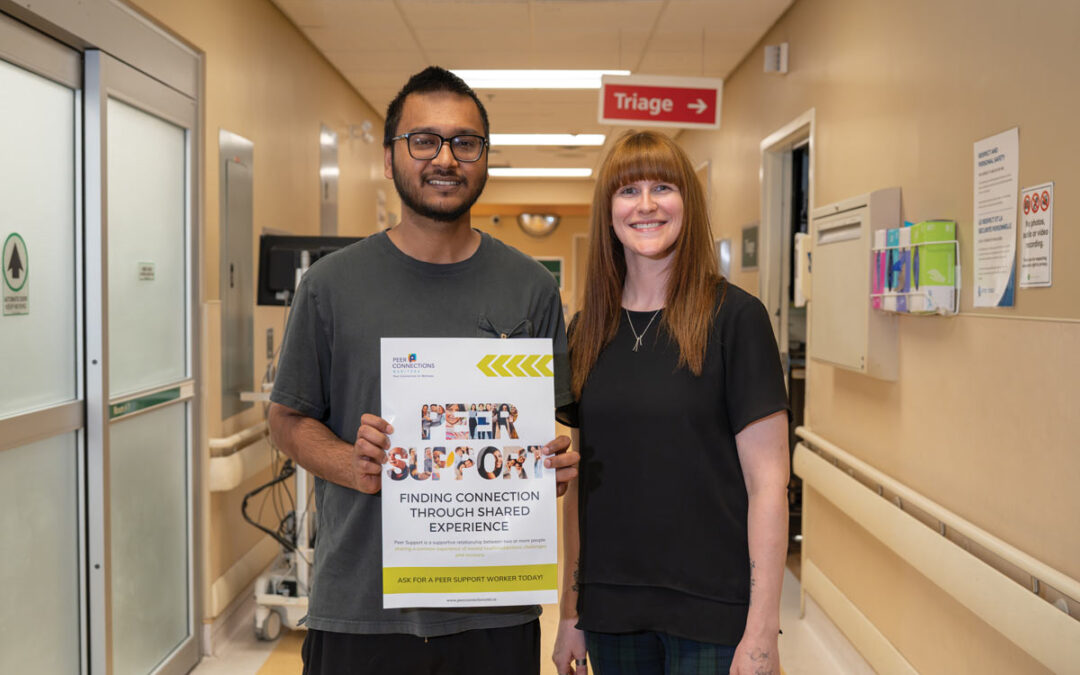
A new pilot project brings peer support to Urgent Care
Seven Oaks General Hospital is leading an innovative pilot project that brings peer support into the Urgent Care waiting room. The project explores how connection with non-clinical supports can improve the patient experience, reduce the number of people who leave before receiving care, and better support some of the community’s most vulnerable patients. Launched on May 15, the initiative is the first in Winnipeg to evaluate how peer support can be integrated alongside of clinical care within an Urgent Care setting.
Looking at Safety in New Ways
The pilot grew from a broader effort to reimagine what safety means in a busy Urgent Care environment. A team made up of voices from front-line hospital staff, union groups, senior leadership, security, Indigenous health, and social work examined how to create a safer waiting room for everyone. Looking beyond physical safety, the team noted the impact of different patient experiences on feelings of safety. For people attending without support or facing challenges with homelessness, mental health or substance use, safety may come in the form of offering connection or creating non-judgmental spaces to share.
“It didn’t take long to realize that a certain patient’s perception of safety might look different than another patient’s perception of safety, and to some of our patients, it is about feeling safe enough to attend and feel accepted,” says Leanne Ross, Health Services Manager at Seven Oaks Hospital.
The team also recognized a concerning trend. Patients registering with no fixed address are nearly twice as likely to leave Urgent Care without being seen as those with a permanent address. That incomplete path to care puts an already vulnerable population at higher risk of negative health outcomes.
The Pilot in Action
The six-month pilot places a trained peer support worker from Peer Connections Manitoba in the Urgent Care waiting room on Friday and Saturday evenings. Peer Supporters combine lived experience with specialized training in trauma-informed care, de-escalation, and cultural awareness, allowing them to build trust in ways that complement clinical care.
“The uniqueness about peer support is that we get to let our lived experience lead the conversation. We don’t come in with any kind of agenda. We’re just there, meeting another human being in the moment they are at,” says Katharine Dixon, Peer Support Manager, Peer Connections Manitoba. “Where we can have conversations that are fully confidential and we’re allowed to get curious, to discover, to ask questions, and to collaborate with another human being on what they might be going through in that moment.”
Peer support fits alongside the clinical team’s work without changing medical care or workflows. Peer Supporter Tanvir receives referrals from triage and makes connections through conversations in the waiting room, offering support adapted to the patient and situation. Sometimes that means sitting with someone who is anxious or in pain. Other times, it means providing the comfort of a blanket, helping someone communicate with healthcare staff, or simply checking in to let them know they have not been forgotten.
“The work they’re doing is really empowering the individuals to advocate for themselves, to share safely and openly, and to establish a trusting relationship with the healthcare team,” says Ross.
The Support Also Extends Beyond the Waiting Room
“I let patients know that, if they are comfortable with it, I can do a follow-up with them,” says Tanvir, Peer Support. “If they have someone follow-up with them, they don’t feel that they have been left alone.”
For patients who choose to participate, support can continue after they leave the hospital through a four-week follow-up call. Those who would benefit from longer-term support may also be referred to Peer Connections Manitoba’s community peer support program for up to one year.
“Some of the gaps we see aren’t necessarily solved by adding more nurses or more security,” says Leanne Ross, Health Services Manager, Urgent Care. “Sometimes they’re those simple moments of connection that remind people they haven’t been forgotten.”
The benefits extend to staff as well. Nurses report that having someone available to check on patients, answer questions about wait times and provide comfort measures helps ease some of the pressure during busy shifts, allowing clinical staff to focus on patient assessment and treatment.
While the pilot is still in its early stages, initial demand has exceeded expectations, and evaluation is underway to measure patient experience, rates of patients leaving without being seen and other key outcomes. If the data supports it, one small pilot could provide a model for delivering more compassionate, equitable and connected care.
At its heart, the pilot reflects Seven Oaks General Hospital’s commitment to finding innovative, collaborative solutions that improve patient care while strengthening support for healthcare teams. By combining clinical expertise with peer support, the project is exploring new ways to make every patient feel seen, supported and safe from the moment they walk through the doors.
Anyone interested in accessing Peer Connections Manitoba’s peer support outside of the pilot program can find Quick-Access Peer Support on Saturdays at 100-4 Fort Street or can sign up for 1 on 1 peer support sessions at peerconnectionsmb.ca.